

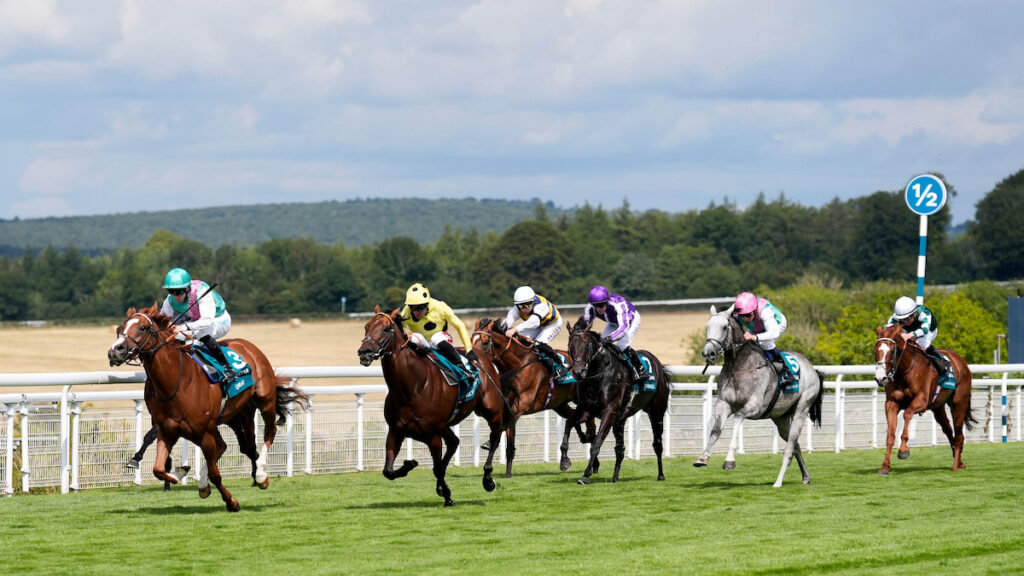
The use of pacemakers in sport is certainly not a recent development. In Athletics, for example, pacemakers are generally championed to ensure a strong tempo. In 1954, Sir Roger Bannister broke the four-minute barrier with the aid of Chris Brasher and Christopher Chataway.
One of the most famous accounts in horse racing is Bullet Train, who so often set the fractions for Frankel. Without Bullet Train, Frankel may never have reached such heights, nor would he have produced so many exceptional thoroughbreds.
In the recent months, however, the topic of pacemakers has accelerated for multiple reasons, largely down to the nature of ‘team tactics’, which is essentially forbidden in the sport.
In the St James’s Palace Stakes in June, Christophe Soumillon was initially banned for allegedly riding to benefit a stablemate. It appeared as if Soumillon had edged off the rail to give Ryan Moore, on Gstaad, a clean run. However, the ban was reduced to five days on appeal on account of interference as opposed to ‘team tactics’.
That incident has somewhat propelled the nature of pacemakers strongly into the racing discourse, with BHA’s Brett Dunshea stating the role will be discussed at the next IFHA meeting.
Dunshea told the Press Association, via At The Races: “Pacemakers is a regular topic that comes up. I was actually chatting at York last week with a number of leading trainers about the issue.
“We’re always open to hearing views on topical issues like this where there could be an opportunity to improve the regulation of the sport. Pacemakers and the way they operate here in this part of the world are not something that is necessarily acceptable in other parts of the world. There are other approaches to it.
Regulations should be applied ‘consistent(ly)’ across the racing world, suggests Dunshea
In some jurisdictions, both in racing and outside of racing, pacemakers are declared to the public beforehand. This is particularly key in order for the betting public. Betting and racing are intrinsically linked, and punters should be given a fair, level playing ground for their money. One could argue that part of the puzzle is to decipher those administering dark arts, however.
Dunshea expanded, stating: “It’s an interesting one that I was intending to raise with the IFHA’s international rules committee. To get an understanding of whether there is a global position on this.
“The IHFA has established a collective global group that looks at the idea of trying to harmonise our rules. So that regulations are applied to racing consistent the world over. This is one area where there is an inconsistent approach globally. It is one issue that I will be raising and debating at that international forum.”
It’ll be interesting should the rules be adapted to clamp down on pace-makers, though it is certainly a topic of conversation that isn’t fading any time soon.