

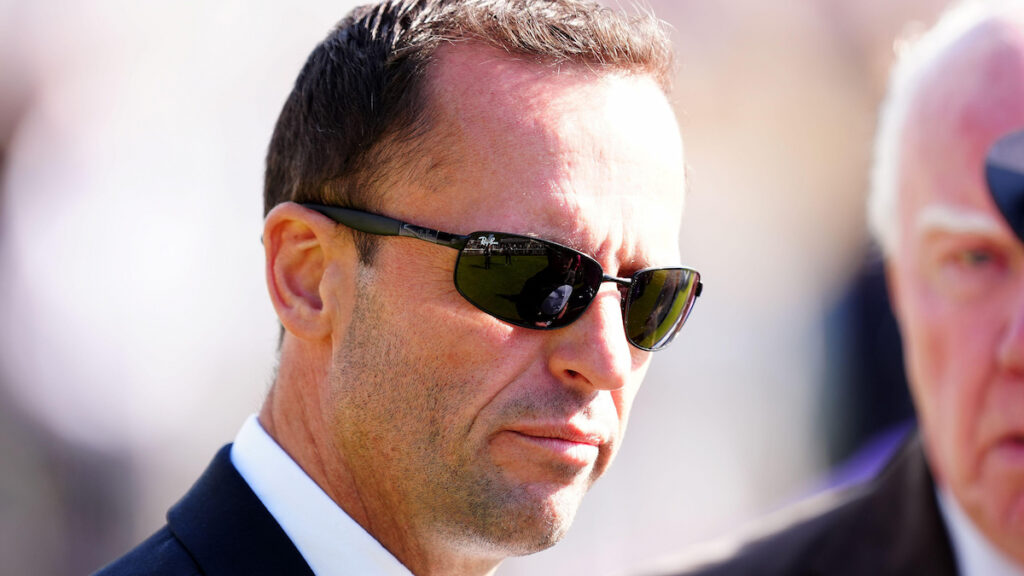
Over a year and half has passed since Craig Lidster returned to his beloved Malton following his departure from Eboracum Racing Stables in Easingwold.
During his tenure there, Lidster rapidly cultivated himself as one of the North’s rising training stars, with star filly Alfa Kellenic acting as the flag bearer following a remarkable six-timer, culminating with success in the 2024 Ayr Silver Cup.
Despite beginning his journey at Beverley House Stables with a significantly depleted string of horses, Lidster capped off 2025 with 20 winners, a target he aimed to hit, setting himself up a strong foundation for his full first season in 2026.
However, after what’s been an unprecedentedly dry 2026, Lidster hasn’t quite been able to build on the initial promising beginning in Malton.
“One minute they’re up, next minute they’re down” – Lidster
Reflecting on his campaign thus far, Lidster admitted: “The season’s been a bit of a nightmare. Reflecting on the year before, we had a good year. Going into this year, I noticed that something was a bit off in March. I actually called the vets up and stuff like that to say, look, they’re not where they were, where we would want them to be.
“They just always look cold, and the year’s been very messy. One minute they’re up, next minute they’re down. The horses have not been sick, but they’ve not been right.”
It isn’t just the Lidster yard who’ve suffered with the wellness of their string, as he stated there’s “been a bit of dark cloud over the Malton area.” Furthermore, the issue has extended across the racing nation as Lidster referred to the recent illness’ at Ballydoyle, despite having “the best biosecurity on the planet.”
When asked whether he’s been able to attribute the issues down to anything particular, Lidster said: “I think it’s obviously a bit of a national thing. Some people might disagree. I don’t know whether it was a bit of a winter thing, and then obviously we were kind of blaming it on the pollen early doors, which you always kind of get anyway with obviously the rapeseed, which even if it’s not close by, it could be 20 fields away, but it still picks up and carries.”
The rapeseed has affected many racing yards, in particular Jane Williams’ who had to temporarily shut down her yard due to the rapeseed oil crops in a neighbouring farm.
The problem has been exacerbated this season, as Lidster explains: “we ended up with three months of basically no rain, and obviously you don’t see the dust, but it is very dusty, and obviously horses breathing that is obviously not great, you know. It’s been a headache, it’s just one of those years you could think about forgetting.”
The Two-Year-Old Conundrum
Having developed a strength in the breaking in of two-year-olds at the late Sir Robert Ogden’s, before working with the likes of Wootton Bassett at Richard Fahey’s, Lidster has prided himself on the success of two-year-olds.
However, combined with the changes to the fixture list, Lidster highlighted the damaging ramifications the weather has had upon his juveniles. The BHA announced last year that they would be removing the 0-50 and 0-55 rating bands from the nursery programme, with 0-65 the lowest band available for juveniles.
Lidster discussed the negative effect this has had not only on his string, but the logistics of his business: “Our two-year-olds have not really wanted rattling ground. They’ve ended up getting their handicaps marks, but now we’re struggling to get them into races off marks of 54’s etc and the races aren’t there for them.
“The way the book is, we can’t really run any of these two-year-olds until they’re three-year-olds, basically. If you do get in (to the 0-65s and above), it’s only by chance. But you’re taking on horses that are theoretically 10, 15lbs above you – it’s unfair to these two-year-olds.”
While the changes were implemented to try and improve the competitiveness and overall field sizes, Lidster also suggested that: “I don’t think it’s done probably the breeding operations any favours, where some of these two-year-olds could have actually won small handicaps for the mares to go onto the books, ready for the yearlings going forward this year.”
I’ve got a nice horse in Kody B who goes to Newcastle on Thursday. He’s in a three-year old only race and won his novice on the grass by four or five lengths as a two-year-old on soft ground. If he takes to the all weather, maybe we might just keep him to the all weather and obviously go for the arc points.
Winter is coming
While the flat season is officially drawing to a close, the hard graft doesn’t stop for the yards. Some of the horses are to embark on an all-weather campaign, whereas others begin to wind down and strengthen up for the following season.
At Beverley House Stables, Lidster said: “Once we start winding them down, we try and get them out to the paddock for as long as we can, look, we like horses to be horses, you know. We’ll have 20 horses turned out in our four-acre paddock every day when there’s no rain.
“We’ll farm them off to different places and get them out onto the grass. Obviously, come winter, then you know you’re going into the back end of the year, and there’s not actually much goodness actually in the grass.
“Even though your grass looks great, you know you’ve got a lot of greenness in the grass. It’s not actually that goodness has really gone. You start to deplete, so having to feed him the hard grub to obviously bulk him back up.
“We have a bit of a philosophy: if a horse has a dry back and food in his belly, he’ll actually do really well during the winter. So we try and rub them up as much as we can, and they do well during the winter, so they’re bigger and stronger to come back in as a three-year-old, four-year-old, five-year-old. Ready for the season ahead.”
The all-weather provides a solid incentive over the winter for owners and trainers to continue running their horses, and Lidster has already begun to plot his way through the fixture list with some of his string.
“I’ve got a nice horse in Kody B who goes to Newcastle on Thursday. He’s in a three-year old only race and won his novice on the grass by four or five lengths as a two-year-old on soft ground. If he takes to the all weather, maybe we might just keep him to the all weather and obviously go for the arc points.
“Billy B’s just had a bit of an up and down year. He ran an absolute belt at Pontefract there the other day. He didn’t get into the amateur race at Ascot on, so he potentially could, which he does actually go on the all weather. He could potentially run this winter on the all weather. I don’t know how far I will go into the winter with him because obviously he’s getting older and wiser, and he likes to get his toe in.
Lidster also gave a mention to some of his back end two-year-olds who he’s keen to run, including “Another Festival – lovely big filly. We’ve just took our time with her, so she’s had an entry but whether she’ll run or not. But she’ll probably go into the winter.
“Another Yorkshire Racer horse called Ubettanotblink. He just gave him a really bad handicap mark there of 33, which was disappointing. Really, I think I need to have a word with him about that. I’ve had to run him in open novices because I couldn’t really get him into some races where I wanted him close by.
“So yeah, we’ve got a couple to go out. Not masses this year, but we do have a couple to go at, so, and we’ll see what we’ve got in the horses in training sales, see If we can pick something up to try and fire at these points for the winter series going forward.”