


I was quite lucky to be born into a family of Manchester United fans this millennium. Throughout my childhood and up until 2013, all I knew was success. It was the norm: seven Premier League titles, three League Cups, an FA Cup and a Champions League.
I woke up on Monday morning after we’d been beaten 3-0 at home by Bournemouth – a team who were relegated to League Two just as we’d won the Champions League – and it was an indescribable feeling. There was no sense of shock, anger or frustration, merely acceptance. An acceptance that this is who we are: a mediocre establishment still hanging on to the coattails of the glory days.
I then looked at the entries for the Charlie Hall Chase this weekend, a race won by the likes of Wayward Lad, See More Business, Silviniaco Conti, Cue Card and Bristol De Mai. This race was once a crucial fixture in the campaign of a true Grade 1 chaser, who’d often go on to win King Georges, Betfair Chases and Gold Cups.
The top-rated horse entered is Pic D’Orhy on 162. An inflated rating at that: he’s an 11-year-old who’s 10lb better going right-handed and was second to a suspect stayer at the trip in this race last season. It’s a field of largely bang-average 150-rated horses, none of whom should even be mentioned in the same breath as some of the historic winners of this race.
That isn’t to the detriment of their individual achievements; after all, there are Grade 1 winners in here and a Cheltenham Festival winner. But even Manchester United have won an FA Cup recently.
There it was again, that feeling of acceptance. Like Manchester United, the dominant days of the British staying chaser at the pinnacle of the sport appear long gone.
Irish domination
The red tide began to turn blue in the early 2010s, as Manchester City won their first league title since 1968 in 2012. The same year, Willie Mullins won the Mares’ Hurdle with Quevega for the fourth year in a row, on the way to six straight wins in the race. He also won the Jewson Novices’ Chase with Sir Des Champs, who’d finish second in the Gold Cup a season later. Champagne Fever won the Champion Bumper and went on to win the Supreme a year later, while Mullins also recorded his first Royal Ascot success that season.
Since Sir Alex Ferguson left Manchester United and the blue half of the city began to dominate, Ireland have taken 11 of the 13 Gold Cups, including the last eight since Native River won it for Colin Tizzard in 2018.
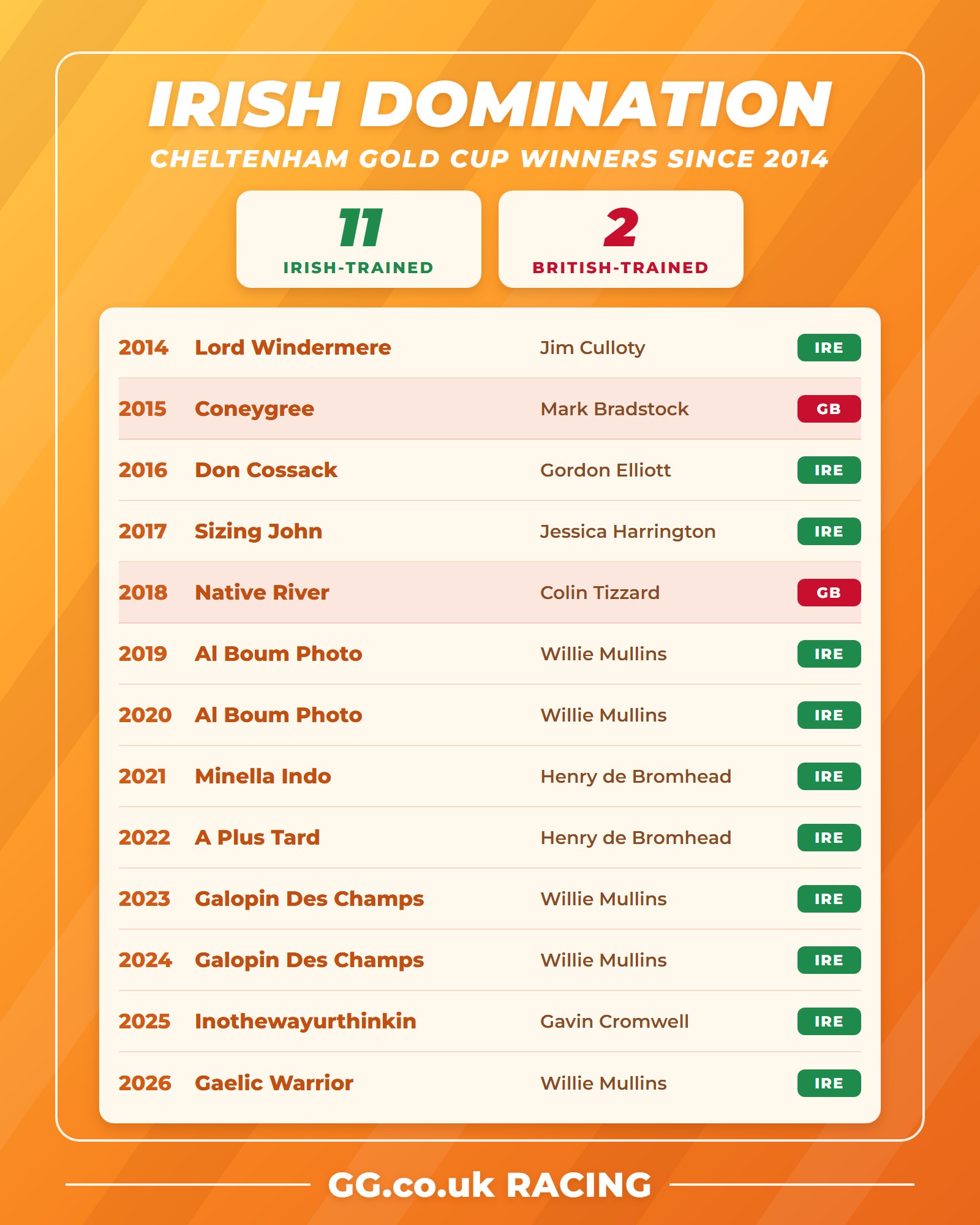
Native River was perhaps one of the last old-fashioned, typically hardy staying chasers that Britain had a knack of producing. Willie Mullins won his first Gold Cup a year later with Al Boum Photo, and he has won four of the seven renewals since.
There are of course several mitigating factors as to why the tide has turned, but they largely bundle together under the fact that Irish racing has undoubtedly invested in the sport, both financially and methodologically, far more smartly than its British counterpart.
The big owners pumping money into the game have migrated across the sea, the pointers are far stronger, the bloodstock agents have invested and continue to invest far more in Irish stock, and the pathway to success is far better at producing talent.
The decision to divert towards sourcing French imports has also been paramount to the Irish success. Six of the last nine Gold Cup winners were French-bred. There is also the factor that the ‘old guard’ of British trainers is a dying breed. Paul Nicholls, Nicky Henderson, Jonjo O’Neill, Colin Tizzard, Henrietta Knight – I think most would agree it’s a fair sentiment that those yards are far from operating at the peak of their powers, particularly in the staying department.
Paul Nicholls especially. The demise of his string in recent years has been well documented. Michael Carrick spoke emotionally at the press conference before the Bournemouth defeat and then had to clap the fans of a broken Stretford End after another spineless performance from so-called professionals. I’d imagine that’s how Paul Nicholls feels as his owners continue to remove their horses from his yard and his protégé Dan Skelton reaps the rewards.
It’s Gaelic, you know, hard to believe he’s not Kauto
So, is there any sign of a resurgence for Britain to reclaim the staying chase division? I’d be amazed if anything can cope with Gaelic Warrior again this season. He’s still only eight years old, but he’s won an Arkle over two miles, the Bowl over three, the Oaksey over the intermediate trip, the John Durkan over 2m3f, the Gold Cup and the Punchestown Gold Cup. And I still don’t think we’ve got to the bottom of him yet.
Jango Baie is perhaps the closest thing we have. He has to find another leg to reverse the Gaelic Warrior form, albeit he was mightily impressive at Aintree. But he’s had a setback. How typical: a resurgent British hope in red and white colours then begins the season injured. Carrick’s Reds, anyone?
Lulamba is perhaps another British hope who shapes as if staying chases will suit. I’d be shocked if he didn’t go up in trip this season. I’m of the opinion that Nicky Henderson will rue not stepping Jonbon up to three miles, and much like Manchester United’s failed attempts to replace Sir Alex, I hope he doesn’t make the same mistake with Lulamba.
Bar those two, and the latter has yet to even win beyond two miles, what on earth do the British have? The Jukebox Man is injured, and I’d love to think Caldwell Potter could make up into a Gold Cup horse – what a story that would be, owned by Sir Alex Ferguson and trained by the redemption-seeking Paul Nicholls. But if we’re sticking to the Manchester United narrative, it’ll be no surprise if he does a Ronaldo-esque U-turn and fails to reignite the spark of the former giant.
Grey Dawning, Jagwar, Sixmilebridge, Haiti Couleurs, Regents Stroll – none of them are simply good enough to topple the Irish.
There it is again, that feeling of acceptance. Much like the Red Devils’ hopes of a return to footballing immortality, the odds are heavily stacked against the British staying chasers getting the better of the Irish and bringing the Gold Cup home. Bleakness in its sincerest form.