


Low stalls have won 18 of the 34 sprints run at Chester this year, 52.9%, which is exactly where the course has been for the last nine seasons. Nothing has changed.
The numbers cover flat races from 5f to 6f 17y, 34 of them in 2026 against 256 across 2017 to 2025. Each field is split into three equal groups by stall number, so a low draw means one of the lowest-numbered stalls in that race.
| Draw | 2026 share of runners | 2026 share of winners (34 races) | 2017-25 share of runners | 2017-25 share of winners (256 races) |
|---|---|---|---|---|
| Low draw | 33.5% | 52.9% (18) | 33.6% | 49.2% (126) |
| Middle draw | 32.9% | 32.4% (11) | 32.8% | 27.3% (70) |
| High draw | 33.5% | 14.7% (5) | 33.6% | 23.4% (60) |
A third of the runners came from the low stalls and they took about half the wins, in line with the long-run 49.2%. High-drawn runners have won just five times, 14.7% against 23.4% over the long run. That is the weakest figure in the table, but it is not outside what Chester has produced before.
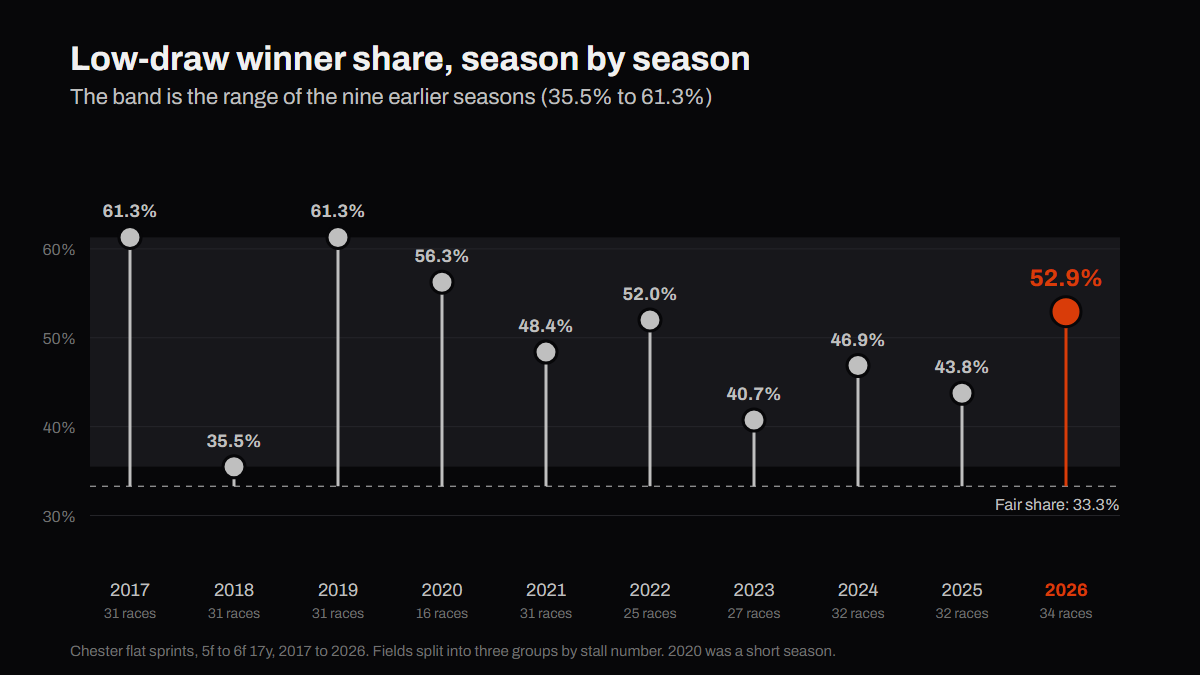
How far these figures normally move is the real test. Across the nine earlier seasons the low draw’s share of winners ran from 35.5% in 2018 to 61.3% in 2017 and 2019, and the low draw won more often than its share of runners in every one of them. This year’s 52.9% sits in the middle of that spread. The high draw has bounced between 12.9% and 35.5%, so 14.7% is on the low side but inside it. The samples are small, from 16 races in the shortened 2020 season to 34 this year, so any single season can swing a long way.
Those figures include every race. Looking only at fields of eight or more, low-drawn runners won 11 of 25 (44.0%) this year against 53.6% over 166 races in 2017-25. That is inside the past range of 35.0% to 66.7% and I would not read anything into it. Nine races this year had seven runners or fewer, which is too few to say anything about.
The widely held view that the low draw edge is a feature of Chester’s sprints has seen 2026 do nothing to dent it. One season cannot tell you why the draw matters in any particular race, but over ten seasons the pattern is hard to argue with.