

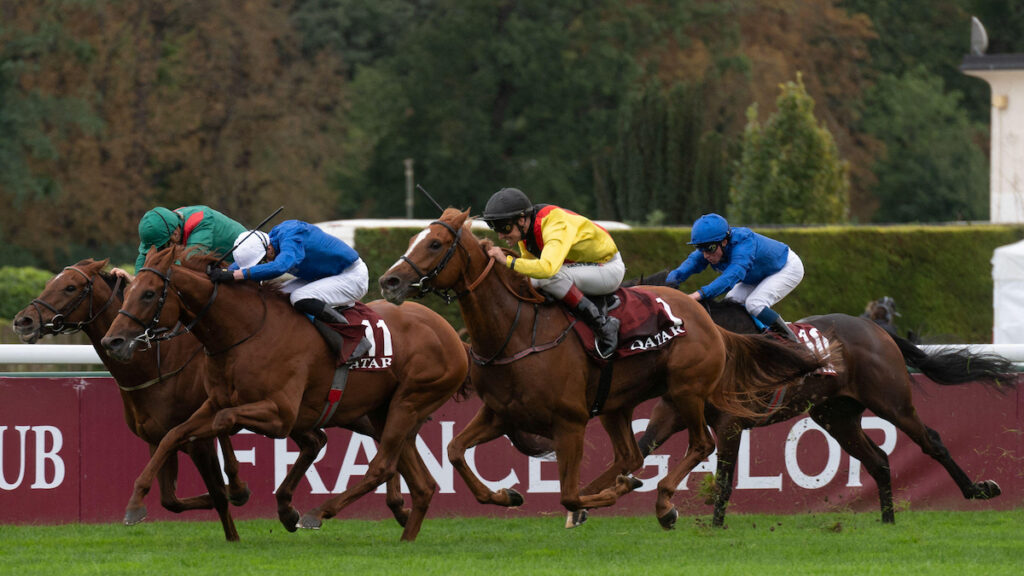
Last year, the Prix de l’Arc de Triomphe forecast emerged from the lowest two stalls as Daryz, drawn in stall 2, repelled the stall 1-berthed Minnie Hauk. Indeed, low stalls have held a clear historical advantage in the Prix de l’Arc de Triomphe at Longchamp, particularly when the field is large, although the ground can make the picture less clear-cut.
We have analysed the 29 runnings from 1995 to 2025, leaving out the two renewals held at Chantilly in 2016 and 2017, to provide the key stats ahead of this year’s renewal, with the draw for the 2026 Arc occurring on Thursday.
The inside eight have dominated
Stalls 1–8 and stalls 9 and higher have had almost identical representation in the sample: 229 runners compared with 225. The winning record is not close. The inside eight have supplied 24 of the 29 winners, while stalls 9 and higher have supplied just five.
| Draw band | Runners | Winners | Win rate | Top-three finishes |
|---|---|---|---|---|
| Stalls 1–4 | 114 | 11 | 9.6% | 36 |
| Stalls 5–8 | 115 | 13 | 11.3% | 18 |
| Stalls 9–12 | 106 | 1 | 0.9% | 20 |
| Stalls 13+ | 119 | 4 | 3.4% | 14 |
Only two renewals in the study had 10 runners or fewer: the 2000 Arc, won by Sinndar from stall 7, and the 2006 Arc, where Rail Link won from stall 4. That matters because a low-draw record can be less meaningful in a small field. However, the edge remains visible even with regularly large fields.
Remarkably, every Arc in the study with 18 or more runners was won by a horse drawn from stalls 2–8, a stat which covers eight races: 1997, 2004, 2009, 2010, 2012, 2014, 2018 and 2022. Moreover, the winner and runner-up were both drawn in stalls 1–8 in 15 of the 29 renewals, more than half of the runnings since 1995.
It is a pattern consistent with the Longchamp layout. The 2,400-metre start gives the field a run towards the first bend, where a low draw can help a horse hold a position nearer the inside and avoid covering unnecessary ground. Iinside runners travel a slightly shorter distance, but pace, race position and the individual horse still matter, but the scale of the difference here makes it more than a passing trend.
Stall 1: the place draw rather than the winning draw
Stall 1 tells the more nuanced side of the draw story. It has produced only one winner from 29 runners — Zarkava in 2008 — but it has supplied 11 top-three finishes, the best placing record of any individual stall in the sample.
| Stall | Runs | Wins | Win rate | Top-three finishes | Top-three rate |
|---|---|---|---|---|---|
| 1 | 29 | 1 | 3% | 11 | 38% |
| 2 | 29 | 3 | 10% | 8 | 28% |
| 3 | 28 | 4 | 14% | 9 | 32% |
| 4 | 28 | 3 | 11% | 8 | 29% |
Six stall-1 runners have finished second. Its recent places include Sottsass, third in 2019, and runners-up In Swoop, Westover and Minnie Hauk. The rail can offer an economical route, but it can also leave a horse needing racing room at a crucial point. That may help explain why stall 1 has been so productive for places without matching the winning record of the stalls immediately alongside it.
Why stall 9 has become the Arc’s unlucky draw
Stall 9 is the clearest individual anomaly. It has supplied 28 runners and nine top-three finishes, including Enable’s second in 2019, but no winner. It has been good enough to get horses into the frame, without converting one into an Arc victory. Urban Sea was the previous stall-9 Arc winner, in 1993.
The broader middle-of-the-draw record is even more striking. Stalls 9, 10 and 11 have sent out 80 runners between them without producing a winner. Stalls 16 and higher are also winless: 48 runners have produced no winner and only four top-three finishes.
| Stall group | Runners | Winners | Top-three finishes | What the record says |
|---|---|---|---|---|
| 9 | 28 | 0 | 9 | Plenty of places, no winner |
| 9–11 | 80 | 0 | 19 | Winless middle section |
| 16+ | 48 | 0 | 4 | Winless widest draws |
Only four horses drawn in stall 16 or wider have made the first three: Cavalryman, Orfevre, Masterstroke and Torquator Tasso. The widest winning stall in the sample is 15, achieved by Sakhee in 2001 and Treve in 2013.
Soft ground gives the wider draws more of a chance
The low-draw advantage is strongest on good, good to soft or good to firm ground. In those 15 runnings, 14 winners came from stalls 1–8 and only Golden Horn, from stall 14 in 2015, won from stall 9 or higher under an enterprising Frankie Dettori ride. A low draw can be most helpful when the ground is fast and the rail is at its innermost position.
| Going group | Races | Average winning stall | Winners from stalls 1–8 | Winners from stalls 9+ |
|---|---|---|---|---|
| Good, good to soft or good to firm | 15 | 5.2 | 14 | 1 |
| Soft, holding, very soft or heavy | 14 | 7.6 | 10 | 4 |
| Very soft or heavy | 10 | 5.5 | 9 | 1 |
That does not mean soft ground removes the inside advantage. Low stalls still produced 10 of the 14 winners on soft, holding, very soft or heavy ground. But it has historically given wider draws a better route into the race: Sakhee, Dalakhani, Treve and Torquator Tasso were the four winners drawn in stall 9 or higher on those slower surfaces.
The recent very soft and heavy-ground record has still favoured low numbers. Waldgeist, Sottsass, Alpinista, Bluestocking and Daryz won from stalls 3, 4, 6, 3 and 2 respectively. The most useful reading is therefore that testing ground can dilute the draw effect, rather than reverse it.
The historical conclusion
The Arc draw is not a standalone answer to a race, but Longchamp’s recent history makes it a major part of the pre-race picture. The inside eight have won 24 of the 29 Longchamp renewals in this study, and their advantage has been most emphatic in the biggest fields. Stalls 1–4 have consistently supplied placed horses, while stalls 5–8 have supplied the most winners.
Whatever happens on Thursday, this is worth significant consideration, particularly if a fancied favourite such as Daryz receives a double-figure berth.