


The John Durkan Memorial Chase at Punchestown has historically been one of the strongest Grade 1s in the early part of the season, and recent renewals have only bolstered the strength of the race.
Only Martin Brassil has toppled Willie Mullins in the last 8 years, and while a prep run was typically had before this contest at the beginning of this century, all of the last 11 winners were having their first start of the season.
I’ve looked at the last 25 renewals alongside the last 10 to see which trends have stood the test of time and which appear to be turning.
KEY TRENDS
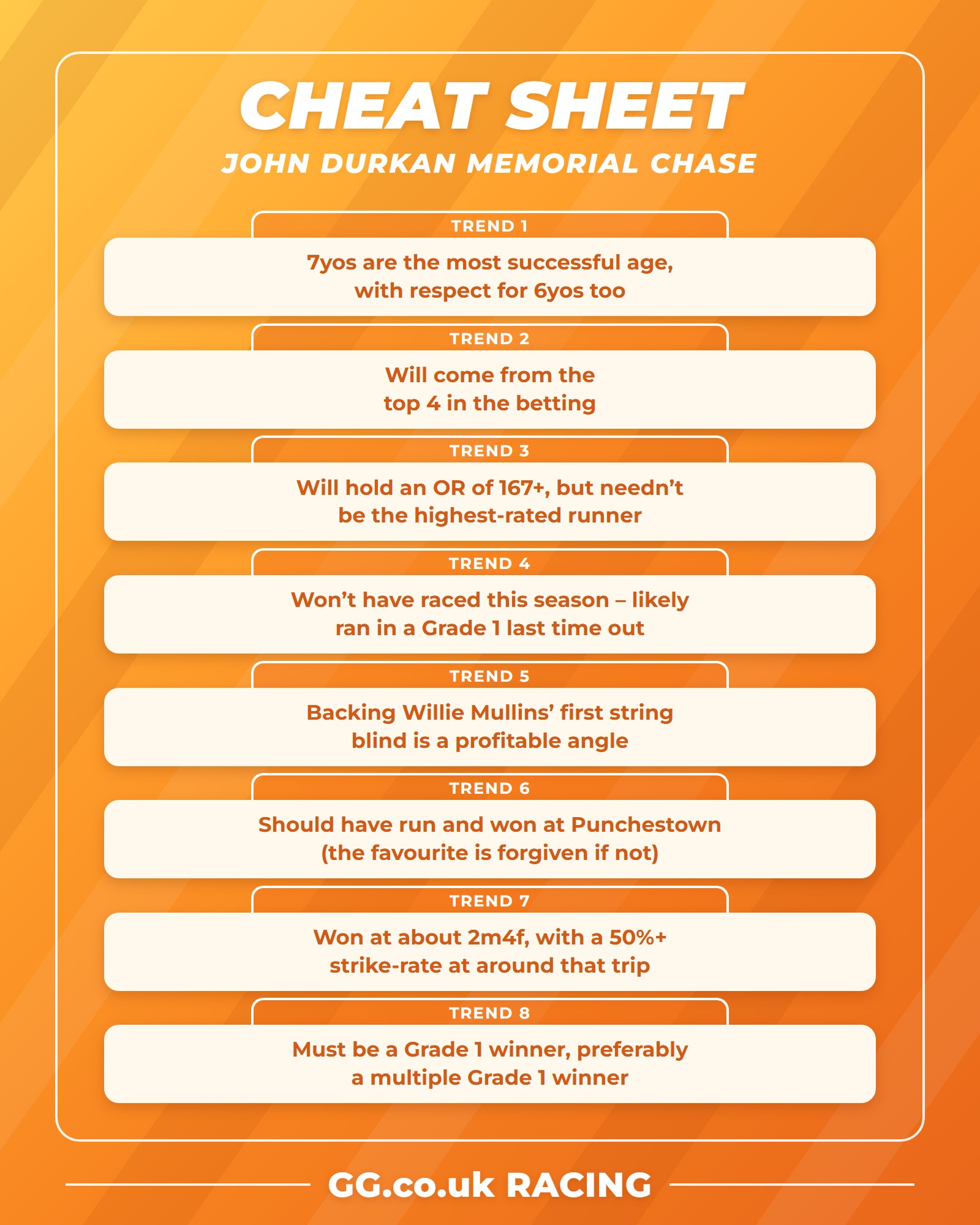
- 7-year-olds are the most successful age, but respect also goes to 6-year-olds
- Will come from the top 4 in the betting
- Will hold an OR of 167 or higher, but doesn’t have to be the highest-rated runner
- Won’t have raced this season and likely came from a Grade 1 last time out
- Backing Willie Mullins’ first string blind is a profitable angle
- Should have run and won at Punchestown, but the favourite can be forgiven if not
- Expected to have won at about 2m4f and hold a 50% or better strike-rate at around that trip
- Must be a Grade 1 winner, and preferably a multiple Grade 1 winner
Focused Trends
AGE
- 6yo – 6/25 (24%) & 1/10 (10%)
- 7yo – 11/25 (44%) & 7/10 (70%)
- 8yo – 5/25 (20%) & 1/10 (10%)
- 9yo – 3/25 (12%) & 1/10 (10%)
There has been no winner older than 9 this century, and in the last 10 renewals, 7yos have dominated but show only a 43p level-stakes profit if backed blind.
7yos are also the most successful age from the last 25 renewals, but again aren’t profitable to back blind, and 6yos hold the best strike-rate at 30%, with 7yos just behind at 26%. Both of those ages have strong place-rates too, so they’re bound to be in the mix.
PRICE
- Favourites – 14/25 (56%) & 5/10 (50%)
- Top 4 in the betting – 25/25 (100%) & 10/10 (100%)
Favourites are profitable to back blind in the long term, but they’re loss-makers in the last 10 renewals. All winners this century came from the top 4 in the betting, which confirms that the market must be respected and the favourite genuinely does hold the best chance.
OFFICIAL RATING
- Winners with an OR of 167 or more – 12/25 (48%) & 9/10 (90%)
- Winners who held the TOP OR – 10/25 (40%) & 6/10 (60%)
There have always been top-class horses winning this race, but there has been a big change in the proportion of winners rated 167 or higher. While that rating expectation has increased, it’s not always the best horse in the race on those figures that lands this contest, and while 6 of the last 10 were the highest-rated runner in the field, none of the last 3 winners were.
LAST TIME OUT
- Ran between 210 and 270 days ago – 10/25 (40%) & 10/10 (100%)
- Ran less than 40 days ago – 14/25 (56%) & 0/10 (0%)
- Ran in a Grade 1 – 13/25 (52%) & 9/10 (90%)
- Won last time out – 11/25 (44%) & 6/10 (60%)
- Prominent in the betting last time out – 24/25 (96%) & 9/10 (90%)
- Ran at about 2m4f – 9/25 (36%) & 3/10 (30%)
- Ran at about 2m – 7/25 (28%) & 3/10 (30%)
- Ran at about 3m – 9/25 (36%) & 4/10 (40%)
The big trend swinger in recent years is whether a horse has raced this season or not, with all of the last 11 winners having NOT raced this season. 11 of the last 12 winners also contested a Grade 1 last time out, and 9 of the last 11 winners came from either the Cheltenham Festival or the Punchestown Festival.
There’s a relatively level split across the distance raced at last time out, between about 2m, 2m4f and 3m, meaning there isn’t going to be a hard and fast rule as to a preferred route into this race, other than being prominent in the betting last time out, with 3 of the last 4 winners sent off favourite on their previous start.
TRAINER
- Trained by Willie Mullins – 11/25 (44%) & 8/10 (80%)
It might not sound very informative to say that Willie Mullins has a stranglehold on any race, but this has become a home game for him. 8 of the last 10 (and 9 of the last 11) winners were trained at Closutton, and this century you can add 2 more. One of those winners was Florida Pearl back in 2001, but he didn’t have another runner until 2007, and then it took until 2013 for him to land another renewal.
Since and including then, he’s won 10 of the 13 renewals, and only two winners were not his first string. They were the last two years’ winners, though, Gaelic Warrior and Fact To File. Last year there wasn’t much between the front two in the betting, but the year before, Willie Mullins didn’t train the favourite at all. Allaho won in 2021 and, like Fact To File, was the yard’s first string, with Envoi Allen and Fakir D’Oudairies both ahead of him in the betting.
Backing all of Willie Mullins’ first strings shows a 39% ROI in the last decade and 40% since 2013, when his dominance started. If you backed his first two strings, you’d show a 1% ROI, so the market does know best in the long term.
COURSE FORM
- Winners who had RUN at Punchestown – 21/25 (84%) & 9/10 (90%)
- Winners who had WON at Punchestown – 16/21 (76%) & 8/9 (89%)
- Winners who ran at Punchestown last time out – 7/25 (28%) & 6/10 (60%)
3 of the 4 winners who hadn’t run at Punchestown before were winning favourites of this race, and the other was Fact To File, who wasn’t favourite.
It’s expected that if you’ve been here, you should have won here too, and given Punchestown is home to the last spring festival, it’s not uncommon for the winner of this contest to have last run there, in line with the new profile of a horse who is unraced this season.
DISTANCE FORM
- Winners who had WON at about 2m4f – 24/25 (96%) & 9/10 (90%)
- Winners who had a 50% or better strike-rate at about 2m4f – 20/25 (80%) & 9/10 (90%)
Only Fastorslow in 2023 had NOT won at about 2m4f, and he had tried on 4 occasions. While every other winner had a win at about 2m4f, it’s more interesting that the majority held a 50% or better strike-rate at around that trip, so they were prolific.
CAREER FORM
- Had fewer than 10 runs over fences – 17/25 (68%) & 6/10 (60%)
- Had 3 to 5 wins over fences – 19/25 (76%) & 6/10 (60%)
We can find the majority of winners across both periods by looking for runners with fewer than 10 runs over fences or 3 to 5 wins over fences, but combining the two measures doesn’t make a profitable strategy until you add in a market rank in the top 2, which then shows a 10% ROI and finds 11 winners from the last 25 renewals.
From the last 10 renewals, it finds just 3 winners, though, and shows a negative 35% ROI.
GRADED FORM
- Had already won a Grade 1 – 21/25 (84%) & 10/10 (100%)
- Had already won multiple Grade 1s – 12/25 (48%) & 6/10 (60%)
We’ve seen an uplift in the official rating it takes to land this race, and in line with that, we’ve seen more recent winners who were multiple Grade 1 winners before this race.
Commercial notice: This article on GG.co.uk contains affiliate links. The offers we promote come from operators that we trust and our experts have first-hand experience dealing with. If you open an account through one of these affiliate links then GG will earn revenue. However, we ensure that the money earned goes back into improving and enhancing our coverage of horse racing and other sports, as we look to provide an excellent service to our growing audience.